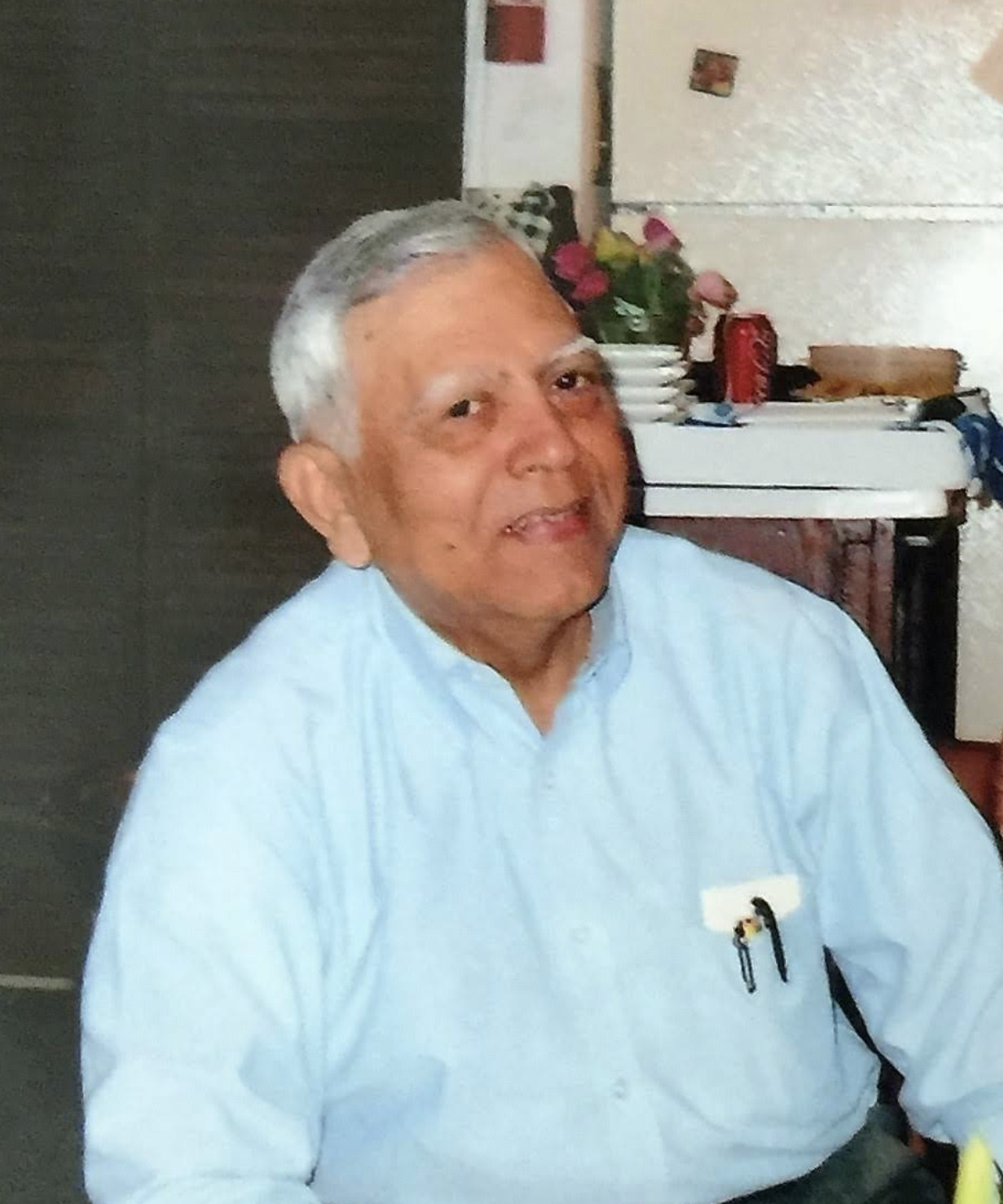
Dr. Haque Interview
‘This interview was conducted by daughter-in-law Jill Sanderson and grandson Charles (at the time age 8!)’ on October of 2016
Jill: We are asking some questions about your life.
Charles: What year were you born?
Riaz: I was born in 1935.
Jill: Where were you born?
Riaz: I was born, according to some papers, in Simla, India. It is a hill resort. My dad used to work for the Viceroy of India so during the summer months, from Dehli, they go over to Simla. Simla was nice and cool. Dehli, down, was very hot. So during the summer months the Viceroy’s office would move to Simla. And so we would go there and stay there for about 6 months. It was a pretty interesting trip. We’d take a train from Dehli to Umbala; from Umbala to Cala and then from there we’d get on a train, narrow gauge, it would have two engines, one in the front and one in the back, because we’d have to go up on the mountain. So one engine would pull and the other one would push. And as we’d go up on the train people would get to feel very nauseated so some people would throw up because we were going so high. The altitude, the oxygen was getting less. But once you get there you get used to it once in a while.
Jill: How old were you when you moved to Pakistan?
Riaz: I was 12.
Jill: And how did that come about?
Riaz: Well, the British were ruling India and people of India wanted to get freedom from the British
people. They wanted to get their country back. So they were two groups of people. One was the Muslim League, these were the Muslim people; and the other one was the Hindus, these were the Hindu people. In the begininng they were under an Indian Congress, all together, they wanted to have one India for everybody. But then they put this idea in some people’s head that “You are Muslim and you have to have your own country” and “You are Hindu and you have to have your own country.” So one person, his name was Muhammad Ali Jinnah, he became involved in getting a separate country for the Muslims. There were a lot of arguments. Ghandi was on one side with Nehru they wanted India to be united. Ghandi and Nehru. They were both Hindus. And there were many Muslims who wanted to be united too.
Jill: What did your parents think? What did your dad think?
Riaz: Well, when it came time the government gave us a choice, whether to stay in India or move to
Pakistan. My dad decided to stay in India because he had a nice business going on in India. He was
working for the Viceroy house but he was also making a cleaning…he used to experiment in the house
making polishes and ink. And he also had a product that was, you know Ajax over here, it was something like that. It used to be that the competitor of that was was a British product called Vim. And so dad started a product called FIP, Fine Industrial Product. He would take the samples to his office and give it to the cleaning crew to try it out. And then the Health Commissioner of India would come to the Viceroy’s house, because he was the Health Commissioner of Delhi, he would come and he asked the people “What are you using because everything looks so clean?” So they said “Oh, Haque brings this powder and we are using it.” So he got ahold of my dad and he said “This is a good product, let’s market it.” Then they started a little factory. In our home, I and my sister and my mother would make the boxes. We had a roller and a cardboard that we would roll over and it would make a hollow that dad would take them to the Commissioner’s house where they had a machine installed that would put the lids on the bottom and they would also fill up and put the lid on the top and put a label on it.
Jill: What is a Viceroy?
Riaz: Like the governor of a country.
Jill: So your dad was working for the British. So, when India gained it’s independence did the Viceroy
leave? But your dad had this other country to fall back on?
Riaz: We decided to come to Pakistan then. One of the reasons we didn’t go to Pakistan was because of the raw materials of his product was not available in Pakistan. He found in Korta some was available. But it was not a readily available as it was in India. Actually they gave everybody a choice in the government;Whether you wanted to go to Pakistan or stay in India So, my dad put down that we would stay in India. Now my uncle Kashank was the Secretary of the Interior, like Clinton when she was Secretary of State, and what boss was Secretary of the Interior…So the independence had happened but they were choosing who would go where. So my dad said he would stay in India and sent the paper to the Secretary of the Interior and my uncle saw the paper and he called “You’re not going to stay here. I know what’s going to happen here. You have to get out of here” So he changed the papers for my dad to move to Pakistan.
Jill: What did he think was going to happen?
Riaz: In the Interior they knew there were going to be riots.
Jill: Against Muslims?
Riaz: Both. You see there were marches going on. The Muslims would march with the Muslim League and the Hindus, I don’t know what they were marching, Mother India or something. I marched in those
marches too. At the same time the Second World War was going on right before the partition. The
second World War, we were very afraid. We were not allowed to listen to the radio. We would have a
short wave radio, a transitor radio, we would close the windows and darken the windows and inside we would listen closely what was going on with the war. We were not supposed to know what was going on with the war. Even though many many Indian and Pakistani’s were part of the British army. Izaz, my cousin in Montreal, his father was in the army, a major in the army, he went to the Italian front, he was fighting over there. And of course the Gorkha, a part of the British Army. So, the paper was changed of my dad and the partition was going, since we were in the government, the government gave my dad a whole train car for the whole family. My mother, my dad and my sister, everybody we were all there. We were lucky really. We left maybe on the 15th of September, I can’t remember the exact date, but the train that was leaving the next day from Dehli never made it to Lahore. They pulled it on the river bridge, to the center of the river, an important river, they stopped the train and everyone was massacred and thrown into the river. Everybody from the train, children killed…these were the Sikh and the Hindus.
Jill: The Sikh, what were they like? Who were they?